
"mechanical harvesting"
1000 article(s) found

A brief introduction to the description of several flavors and tastes of Brazilian red bourbon coffee
Brazilian red bourbon coffee has several flavors and taste description brief introduction coffee fields are endless, most of them are harvested mechanically, in order to meet the economic benefits. When 75% of the coffee fruit in the coffee garden turns red, mechanical harvesting is started, followed by the same pre-washing operation, which is moved into the sink to remove floating beans, sift out the sunken beans, and then use a large pulp screening machine to dig out the pulp and remove the pods covered with pectin.

Introduction of Rwanda Coffee Flavor producing area Lutexilo, West Province of Malaba Coffee
The biggest harvest season for Rwandan coffee is during the main rainy season, from March to the end of May. During the harvest season, farmers spend most of their day picking coffee fruits by hand. In the afternoon, farmers carry coffee fruits in traditional baskets made of banana leaves to a cleaning station a few hours away. The craftsman picks the best quality coffee fruit with crimson by hand.

World Coffee Manor production area introduction: coffee producing country Brazil Cafes Do Brazil (part two)
Coffee varieties Arabica and Robusta are produced, of which Arabica accounts for 70% to 80%. In Arabica coffee, the more common varieties are Modo Novo, Catuai, Bourbon, Maragoripe and so on. Coffee harvest can have three or four harvest seasons in a year. Mechanical picking is very common. The method of picking is very different from that of other boutique countries. Mechanical picking process

Introduction to the structure diagram and growth process of coffee bean structure roaster
The harvested coffee berries need further treatment, usually in two ways. Then there is the Qing Dynasty.

Wet treatment of Ugandan Coffee
Professional coffee knowledge exchange more coffee bean information please follow the coffee workshop (Wechat official account cafe_style) Wet treatment: 1. Cherry separation: harvested cherries usually include immature, immature cherries, dried cherries, twigs and leaves. They are lighter than ripe cherries, so they can be removed by flotation, which can be done in a simple vat.

Coffee production in Brazil and coffee bean production in coffee farms
Coffee plantations in Brazil range from large farms mechanized on flat land to small farms harvested artificially in mountain areas. There are no shade trees for shade in Brazilian agricultural gardens. The production of coffee is mainly taken into account, ① production, ② diseases and insect pests ③ quality as far as the stability pursued by agriculture is concerned, the first priority is production. In addition, 80% of Brazilian coffee is dried coffee.
Processing method of raw coffee
The dry processing of dry process is the drying method, in which the fresh coffee fruit is dried into dried fruit, and then the dried peel is removed mechanically to prepare raw coffee. Drying drying of cherry coffee of fresh coffee fruit this operation is to reduce the water content of fresh coffee fruit to facilitate shelling and preservation. Shelling dehusking removes the coffee shell mechanically. Wet processing of fresh fruit in wet process coffee

Description of Rwandan Coffee Flavor introduction to the production area of grinding degree of fine coffee beans
The biggest harvest season for Rwandan coffee is during the main rainy season, from March to the end of May. During the harvest season, farmers spend most of their day picking coffee fruits by hand. In the afternoon, farmers carry coffee fruits in traditional baskets made of banana leaves to a cleaning station a few hours away. The mechanic uses his hands to make the best quality coffee with crimson color.
Coffee production and Coffee Farm in Brazil
Coffee plantations in Brazil range from large farms mechanized on flat land to small farms harvested artificially in mountain areas. There are no shade trees for shade in Brazilian agricultural gardens.
Coffee farms in Brazil
Coffee plantations in Brazil range from large mechanized farms on flat land to small farms harvested manually in mountainous areas. Brazilian farms have no shade trees for shade.

Introduction of Arabica Coffee Bean picking Map characteristics, Price, Origin Flavor description, taste treatment method
Arabica coffee bean picking map characteristics price producing area flavor description taste treatment method. Mechanical picking is suitable for coffee gardens with flat land and large areas of plantation. afterwards, it is necessary to check the coffee beans picked by the machine and pick out the leaves and branches that have fallen in the funnel. This method is often used in Brazil. Advantages: low cost, high efficiency, disadvantages: automated machine harvesting will harvest

Flavor description of Salvadoran coffee beans introduction to manors in producing areas
Flavor description of Salvadoran coffee beans the characteristics of varieties in producing areas introduce the endless coffee fields, most of which are harvested mechanically in order to meet the economic benefits. When 75% of the coffee fruit in the coffee garden turns red, it starts to be harvested mechanically, followed by the same pre-operation of washing, moving into the sink to remove the floating beans, sifting out the sunken beans, and then using a large pulp screening machine to dig out the pulp.

The treatment method of half-sun-dried coffee and raw beans
Brazilian half-sun-natural removal of pectin: Brazil used to use the sun method in the past, the quality varies greatly, so that Brazil Yu is synonymous with middle and lower quality. However, in order to improve its quality and reverse its image, the world's largest coffee producer carried out a quality revolution in the 1990s and vigorously promoted the global half-sun method. Brazilian coffee fields are endless and are mostly harvested mechanically to conform to the classics.

Aroma of El Salvador Mercedes Manor Coffee Flavor description Grinding degree Taste characteristics
Coffee fields are endless, and most of them are harvested by machinery, which is in line with economic benefits. When 75% of the coffee fruit in the coffee garden turns red, mechanical harvesting is started, followed by the same pre-washing operation, which is moved into the sink to remove floating beans, sift out the sunken beans, and then use a large pulp screening machine to dig out the pulp and remove the pods covered with pectin. The next stage is separated from the washing method: sticky beans.

Introduction to the characteristics of grindability of slightly sour Salvadoran Himalayan coffee varieties in producing areas
Coffee fields are endless, and most of them are harvested by machinery, which is in line with economic benefits. When 75% of the coffee fruit in the coffee garden turns red, mechanical harvesting is started, followed by the same pre-washing operation, which is moved into the sink to remove floating beans, sift out the sunken beans, and then use a large pulp screening machine to dig out the pulp and remove the pods covered with pectin. The next stage is separated from the washing method: sticky beans.

Introduction to the origin of Serrado coffee in Brazil | what are the characteristics of coffee cultivation in Cerrado producing areas
The word Cerrado refers to the savanna, and although it can refer to the prairie that stretches through several Brazilian states, it refers to the Serrado district in the western state of Minas Gerais on coffee. Cerrado coffee is usually clean, has a good body (creamy taste), low acidity, balanced, and may show nutty or even caramel flavor, or even malt, when lightly roasted.

What are the characteristics of coffee in Rwanda
Following Kaiping (official Wechat account vdailycom) found that the coffee harvest season for coffee fruits at the beautiful cafe opened its own shop is during the main rainy season in the area, from March to the end of May. During the harvest season, farmers spend most of their day picking coffee fruits by hand. In the afternoon, the farmer held the coffee fruit in a traditional basket made of banana leaves.

Introduction to the flavor of Rwandan coffee
The maximum harvest season for Rwandan coffee is during the main rainy season, from March to the end of May. During the harvest season, farmers spend most of their day picking coffee fruits by hand. In the afternoon, farmers carry coffee fruits in traditional baskets made of banana leaves to a cleaning station a few hours away. Craftsmen use their hands to improve their quality.

Rwanda Coffee Production Process Geography Climate
Maraba coffee is grown in southern Rwanda, about 12 km (7 mi) from Butare and 150 km (93 mi) from the capital, Gigali. The project began in the Malaba area of Butare province, but was succeeded by local government organizations in 2006, and the area is now part of the Huye region of Southern province. Due to its proximity to the Great Rift Valley and the Newway Forest Mountains, the terrain of this zone
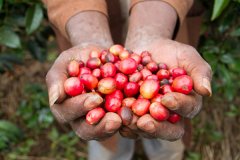
The trend of China's coffee industry is to get rid of the situation of pure raw materials.
The trend of China's coffee industry, represented by Yunnan, China's coffee industry has once again encountered market cycle fluctuations. The government, enterprises and Cajun must take the initiative to turn the crisis into an opportunity. Li Ziliang, a reporter from Newsweek / Outlook Newsweek, entered November. Yunnan Province, China's largest coffee producing area, is about to usher in the harvest season. Pu'er, Dehong and Baoshan are the main coffee producing areas.